The day America said goodbye to JFK: his funeral was 63 years ago today
On Nov. 25, 1963, a state funeral for President John F. Kennedy reached into millions of living rooms. Here is what happened that day, and why the flame at his grave still burns.
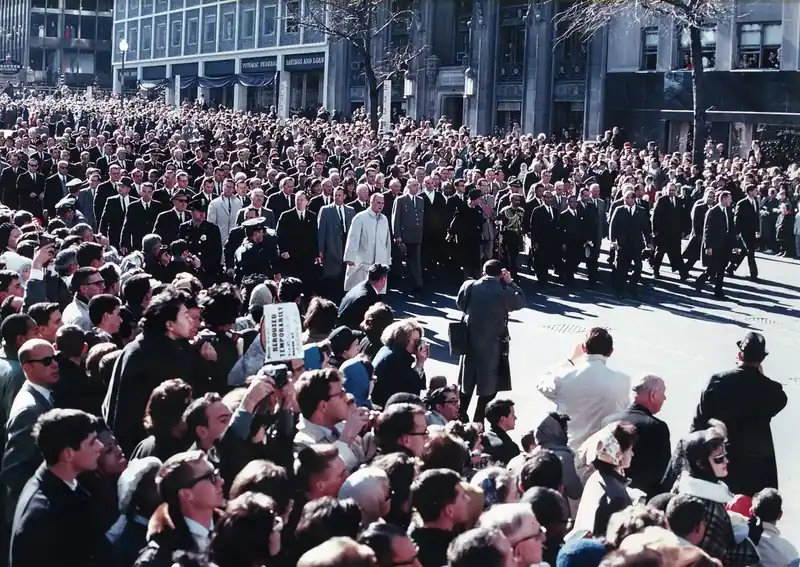
Sixty-three years ago today, on Monday, Nov. 25, 1963, the United States buried its 35th president. According to Arlington National Cemetery, the state funeral of John F. Kennedy began at 3 p.m. that day. It came three days after his assassination in Dallas.
Many Americans who are now 65 or older remember where they were. An Associated Press (AP) retrospective says only 50,300,000 U.S. households had a TV in 1963, and an estimated 41,553,000 sets were tuned to the funeral. This article looks back at that day, using the cemetery's own records and two news retrospectives.
The procession
The day began at the Capitol rotunda, where about a quarter million people had waited in the cold to pass the casket, CBS News reports in its 50th-anniversary look back. From there the family walked behind the horse-drawn caisson (a wheeled cart that carries a casket). CBS says the procession went to the White House and then to St. Matthew's Cathedral, arriving just before noon.
Jacqueline Kennedy and the president's brothers, Robert and Ted Kennedy, walked in the procession, according to CBS. Four horses pulled the caisson, and a riderless horse followed. The AP adds a detail many viewers noticed: the horse, named Black Jack, had boots in the stirrups, turned backward. That is a military tradition for a fallen leader.
A child's salute
Outside the cathedral, Jacqueline Kennedy whispered to her son. The AP says John F. Kennedy Jr. "turned 3 years old on that day." He lifted his right hand to his brow in a small salute to his father's casket. Photographer Stan Stearns captured the moment, CBS reports, and it became one of the best-known pictures of the 20th century.
Cardinal Richard Cushing led the Mass, according to CBS. Leaders from "some 53 countries, including 18 presidents" attended, CBS says. Arlington's records name several, including French President Charles de Gaulle, German Chancellor Ludwig Erhard, Emperor Haile Selassie of Ethiopia and Prince Philip of the United Kingdom.
The burial at Arlington
The burial was at Arlington National Cemetery, across the Potomac River from Washington. According to the cemetery, the first gravesite sat on a sloping hillside on a line between Arlington House and the Lincoln Memorial. CBS says it was in Section 45, and that Kennedy had admired the view from there. Author Robert Poole told CBS that Kennedy said in March 1963: "I could stay here forever."
Several moments stand out in the accounts:
- The flyover. The AP says 50 jet fighters flew overhead in a "missing man formation," a pattern with a gap that honors someone who is gone. Arlington says Air Force One then flew past and dipped its wing.
- The Irish cadets. CBS says Mrs. Kennedy asked for 27 Irish Army cadets, whose silent drill had impressed the president during his visit to Ireland. They were flown to Washington for the burial.
- The salute and taps. A 21-gun salute sounded, the AP says. A bugler played taps and "cracked the sixth note," the AP notes.
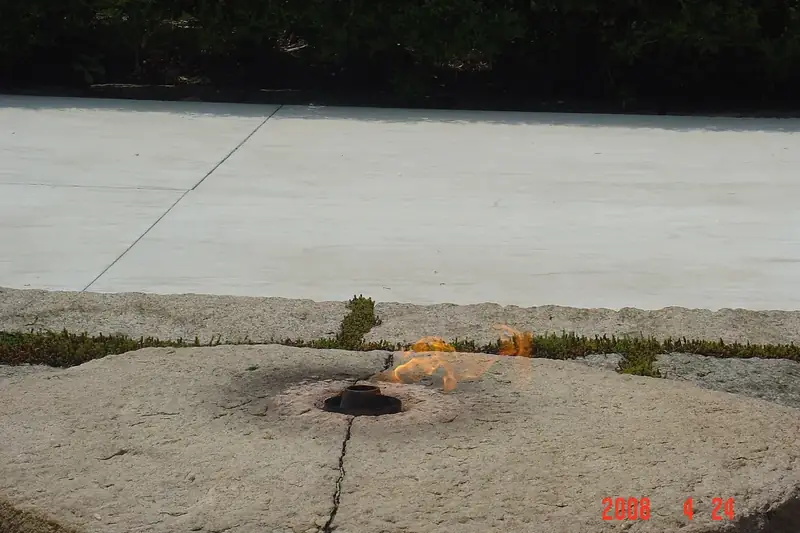
- The flame. Before the casket was lowered, Mrs. Kennedy, with Robert and Ted beside her, lit an eternal flame, CBS reports. Author Robert Poole called it "a last-minute idea" of hers.
The grave after 1963
The funeral changed Arlington. Arlington says live TV coverage led to an "unprecedented increase in demand for burials" there. The cemetery says that in the first year, up to 3,000 people an hour visited the grave, and about 50,000 came on weekends. After three years, more than 16 million people had visited.
The first plot was small, 20 feet by 30 feet, with a white picket fence, Arlington says. A larger memorial was built from 1965 and finished on July 20, 1967. The 1965 federal public works budget included $1,770,000 for improvements in the surrounding area to handle the visiting public. Today, Arlington says, the eternal flame burns from the center of a five-foot circular granite stone at the head of the grave.
What it means for you
If you want to visit, Arlington National Cemetery is open to the public, and the Kennedy gravesite is among its most visited. Check arlingtoncemetery.mil for hours and for the way to reach the site before you go.
If you remember the day, consider writing down what you recall for your children or grandchildren. Memories shared in your own words are a record no book can match.
What we still don't know
The sources do not agree on every detail, and we could not read all of them. We could not open the John F. Kennedy Library's page on the grave. Sources also differ on the "180 million Americans" said to have watched, a figure the AP attributes to one writer of the time. We left it out and used the AP's household count instead. Arlington says the larger memorial was completed in 1967, and we did not find a source in our reading that describes exactly how the first flame was moved to it.
Did you remember?
- Where were you when you learned of President Kennedy's death, and how did you follow the funeral?
- Have you ever visited the grave at Arlington? What do you remember most?
How we checked this story
We read 3 reputable sources, wrote this article in our own words, and link every one of them below. Last checked November 25, 2026.
- Arlington National Cemetery, "President John F. Kennedy Gravesite": funeral start time, dignitaries, flyover, first gravesite, visitor numbers, 1967 memorial, flame
- Associated Press (via NBC10 Philadelphia), "For a Moment, U.S. Stopped to Say Farewell to JFK": TV households, salute, riderless horse, jets, taps, 21-gun salute
- CBS News, "JFK assassination: A nation says goodbye to the president": procession route, Irish cadets, 53 countries, flame lighting, Section 45, Poole quotes
Spot an error? See our corrections policy.