SpaceX catches the top of Starship for the first time, but loses the booster
After 14 orbits, Starship's upper stage returned to its Texas tower and was caught by the launch arms. The booster's return did not go to plan.

SpaceX caught the top half of its giant Starship rocket on Saturday, Nov. 14, using the mechanical arms on its launch tower in Texas. It is a first. The company's other goal for the flight, catching the bottom half too, did not work out.
The flight
The BBC reports Starship lifted off from the Starbase site in Boca Chica, Texas, at 4:47 p.m. local time on Friday. It was the 15th test flight. The rocket stands about 407 feet tall, the Guardian says, and is made of two parts: the Super Heavy booster, with 33 engines, and the Ship on top.
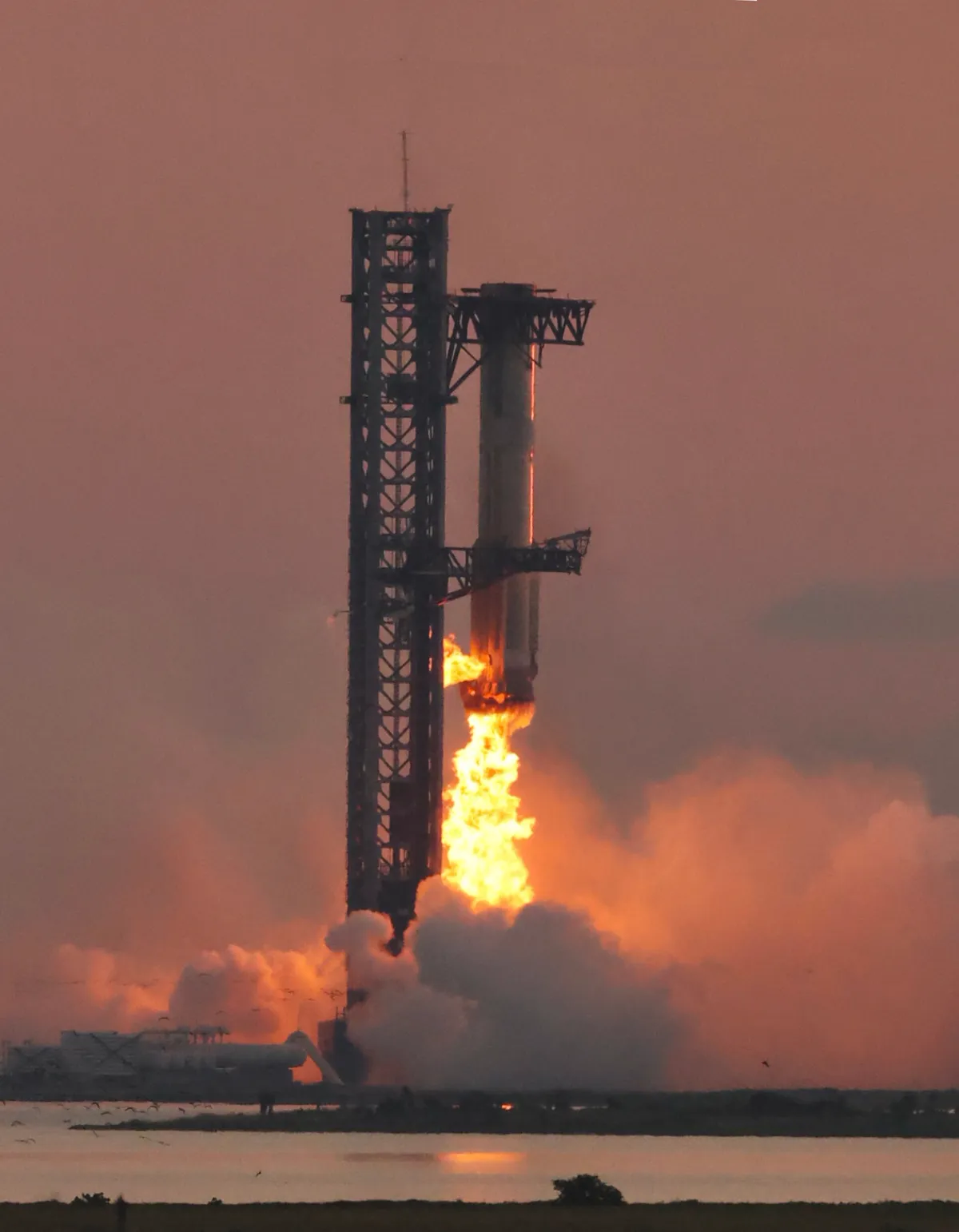
About six and a half minutes after launch, the booster was supposed to return to the tower. Instead, the BBC says, it triggered an automated abort and diverted toward the ocean, where it hovered and then burst into flames. NPR's headline says the booster crashed into the Gulf. Accounts differ a little in detail, but all agree it did not return to the tower. SpaceX's Elon Musk later wrote on X that the booster was "slightly low on fuel," the BBC reports. The Guardian quotes a SpaceX manager, Kate Tice, saying the outcome was not what the team hoped for but was in line with "rigorous safety checks."
The catch
The Ship carried on. According to the BBC it released 26 Starlink satellites, then circled Earth 14 times over about 22 and a half hours. The Guardian adds that three of the satellites carried cameras to check the heat shield, and that SpaceX said it would only try a catch after checking the vehicle in space.
The Ship then came back to Starbase and hovered near the tower, and the arms, nicknamed "chopsticks," closed around it. The BBC says staff cheered. The New York Times reports the spacecraft returned to the same spot it launched from. The BBC notes SpaceX has caught the Super Heavy booster on three earlier flights, but this was the first time the upper stage has been caught.
Why it matters
SpaceX wants both halves of Starship to be reusable, because flying them again and again is how it hopes to cut the cost of reaching space. The BBC quotes Prof. Malcolm Macdonald of the Royal Aeronautical Society: not recovering the booster is a setback, but recovering the Ship is "a substantial step forward," and the next milestone is doing both on one flight.
There is also a NASA connection. The Guardian says NASA has contracted SpaceX, along with Blue Origin, for lunar landers to return astronauts to the Moon in 2028, and the BBC calls that timeline very ambitious. In September, the BBC notes, Starship's Ship reached orbit for the first time.
What to keep in mind
This was a test flight. Neither the booster loss nor its cause has been fully explained, and the Guardian says the reason for the diversion was unknown when it wrote. We will not know how reliable catches are until SpaceX repeats them.
What do you think?
- Do you remember watching the Apollo launches? How does today's rocket news compare?
- Would you want to see a Starship launch in person?
How we checked this story
We read 4 reputable sources, wrote this article in our own words, and link every one of them below. Last checked November 16, 2026.
- BBC News, "SpaceX successfully catches top of huge Starship rocket for first time": flight timeline, satellites, expert quote
- The Guardian, "SpaceX Starship megarocket blasts off before expected return for reuse": size, booster abort, NASA lunar contracts
- NPR, "SpaceX deploys Starlink satellites in Starship test, but booster crashes into Gulf": booster outcome (from the article summary)
- The New York Times, "SpaceX Makes History With Successful Rocket Catch in Texas": ship returned to launch site (from the article summary)
Spot an error? See our corrections policy.