Voyager 1 is about to reach one light-day from Earth, 49 years after launch
On Wednesday morning, NASA's Voyager 1 will be so far away that a radio message from Earth takes a full day to reach it. Here is what that means, and how a 1977 spacecraft is still talking to us.
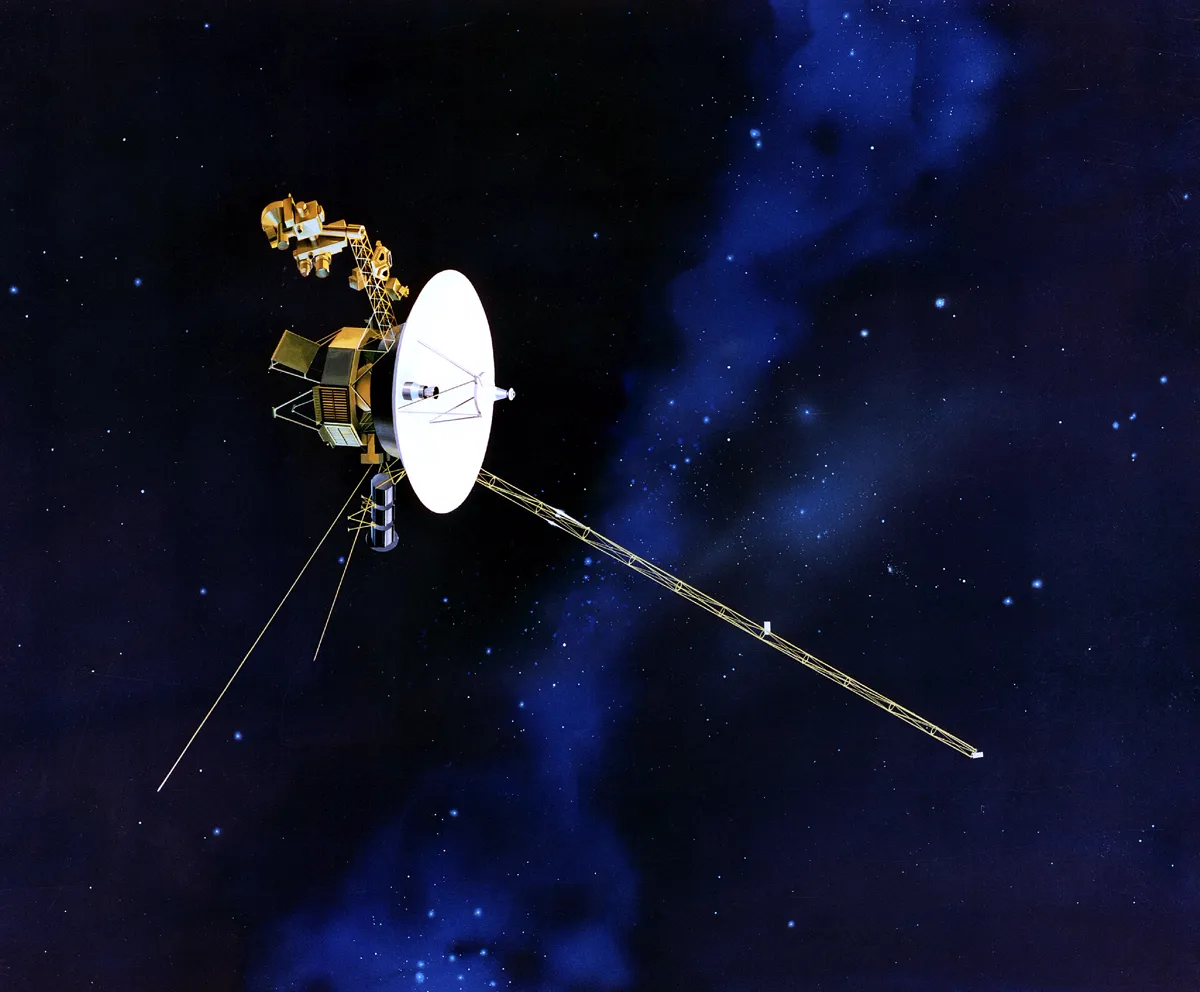
Early on Wednesday, Nov. 18, a spacecraft launched the year Star Wars first hit theaters will cross an invisible line. NASA says Voyager 1 will reach one light-day from Earth at 5:16:07 a.m. Eastern time. No machine built by people has ever been that far away.
What a light-day means
Light is the fastest thing there is. NASA notes that light from the Moon reaches us in about 1.3 seconds, and sunlight takes about 8 minutes and 20 seconds. A light-day is simply how far light travels in 24 hours.
NASA puts that distance at 16,094,799,096 miles, or about 16 billion miles. Science News points out that it is more than four times the distance from the Sun to Pluto. At that range, a command sent from mission control in California takes a whole day to arrive, and the spacecraft's answer takes another day to come back. NASA says the team won't hear back from a Wednesday-morning message until the same time on Thursday.
Getting there took a long time. By NASA's count, the trip will have lasted 49 years, two months and 11 days since Voyager 1 left Florida on Sept. 5, 1977. Its twin, Voyager 2, is on pace to reach the same distance in November 2035.
The mission at a glance
- Aug. 20, 1977: Voyager 2 launches.
- Sept. 5, 1977: Voyager 1 launches.
- 1979: Both probes fly past Jupiter.
- 1980 and 1981: Voyager 1, then Voyager 2, fly past Saturn.
- 1986 and 1989: Voyager 2 visits Uranus, then Neptune.
- Aug. 25, 2012: Voyager 1 enters interstellar space.
- 2018: Voyager 2 follows it out.
- Nov. 18, 2026: Voyager 1 reaches one light-day from Earth.
A grand tour of the giant planets
Voyager 2 actually left first, and Voyager 1 followed two weeks later. NASA says the pair were timed to use a lineup of the outer planets that comes around only once every 176 years, letting each planet's gravity fling the probes onward to the next.
Voyager 1 swept past Jupiter in March 1979 and found a faint ring and two small new moons. In November 1980 it flew by Saturn, discovering five more moons and a new ring, and got a close look at the big moon Titan, whose thick, mostly nitrogen haze hid its surface completely. In 1990, before its cameras were switched off for good, it turned around and took the famous "Pale Blue Dot" picture of Earth as a speck of light.
Voyager 2 took the long way, reaching Uranus in January 1986 and Neptune in August 1989. NASA notes it is still the only spacecraft ever to visit those two planets.
The Golden Record
Each Voyager carries a message for anyone who might find it. It is a gold-plated copper phonograph record about 12 inches (30 centimeters) across, packed in an aluminum case with a needle and cartridge, plus picture instructions showing how to play it and where Earth is.
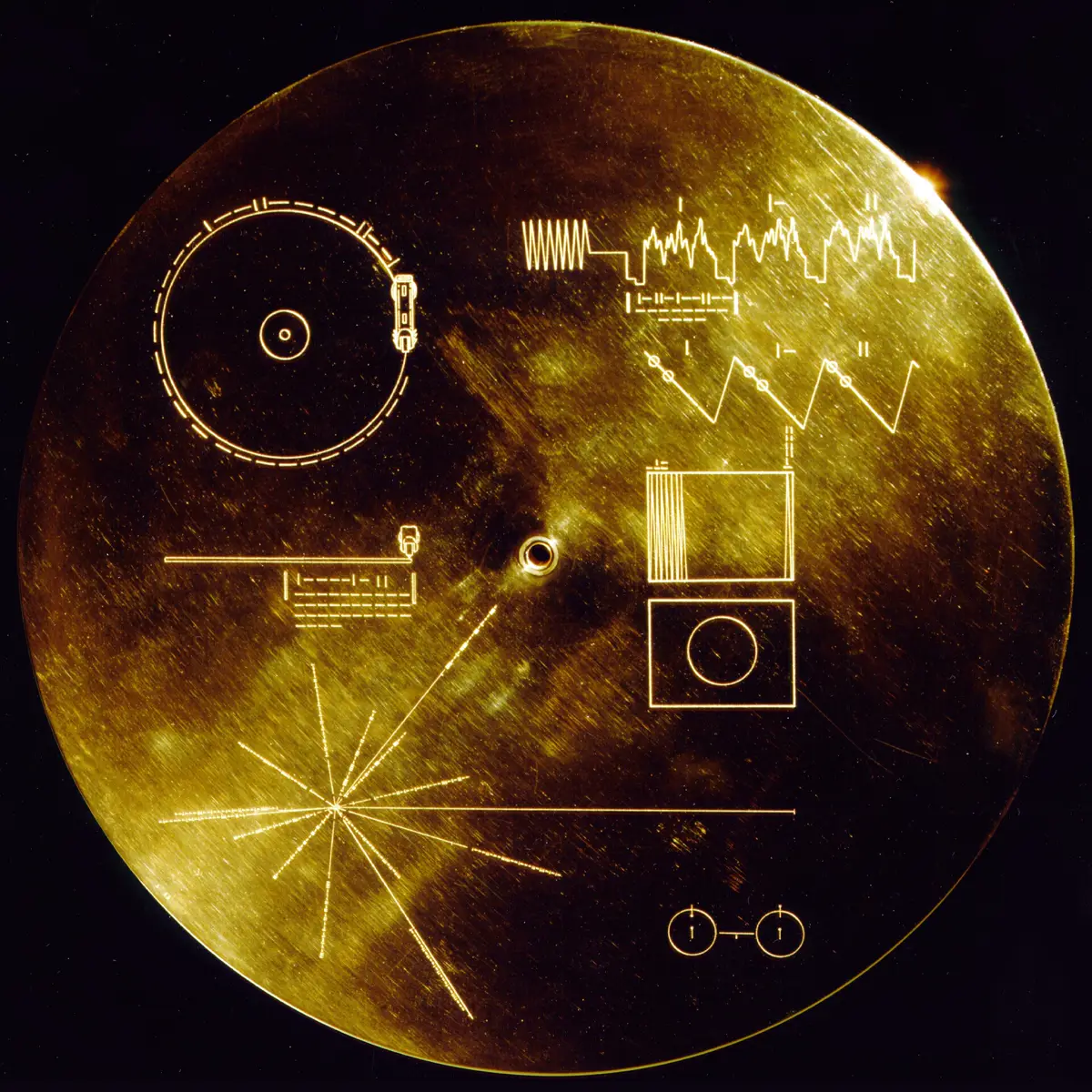
A committee led by astronomer Carl Sagan of Cornell University chose what went on it. According to NASA, the record holds spoken greetings in 55 languages, from ancient Akkadian to a modern Chinese dialect, along with about 90 minutes of music from many cultures. It also carries 115 images and natural sounds such as surf, wind, thunder, birds and whales, plus printed messages from President Jimmy Carter and the U.N. secretary-general. Sagan called it a bottle launched into "the cosmic ocean."
Out past the Sun's bubble
The Sun blows a steady stream of charged particles that forms a huge bubble around the planets, called the heliosphere. Its outer edge is where the Sun's influence gives way to the space between the stars.
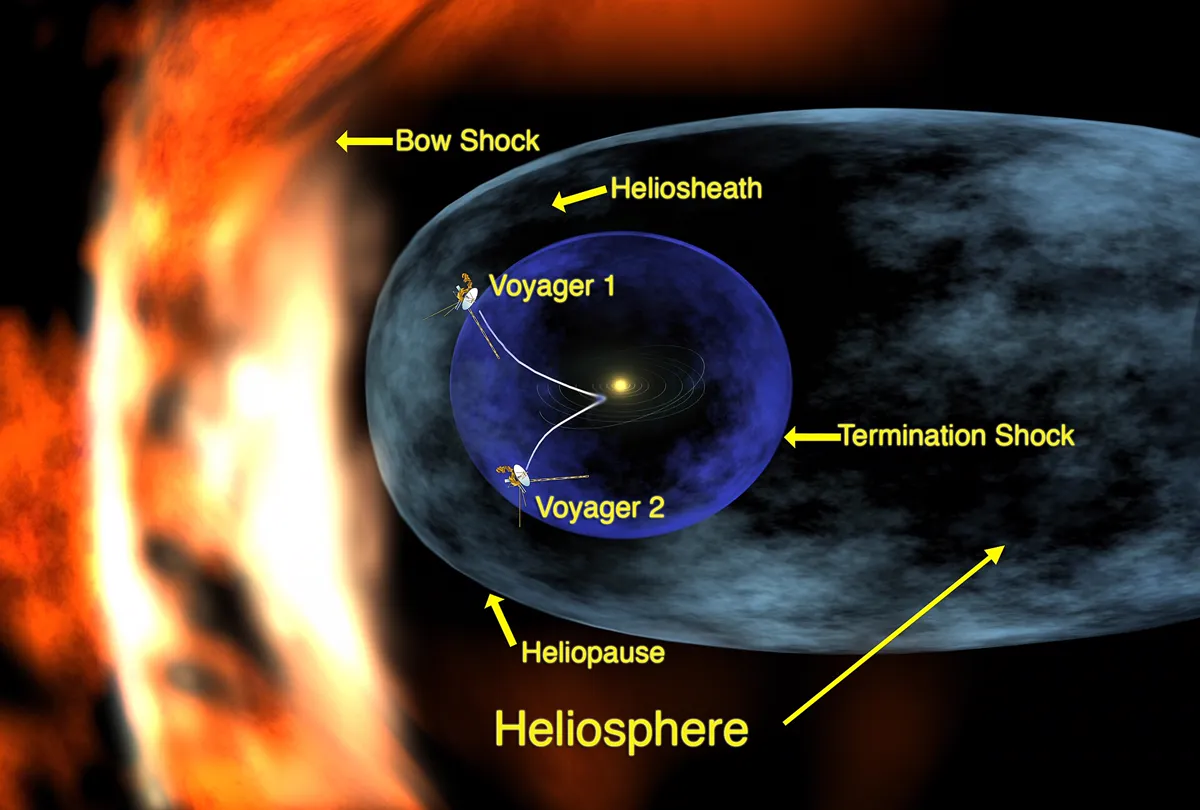
Voyager 1 was the first spacecraft to cross that edge, and Voyager 2 followed on a different route. Neither probe is headed anywhere in particular, but NASA says that in about 40,000 years Voyager 1 will pass within about 1.7 light-years of a faint star called Gliese 445.
How they keep running
The Voyagers do not use solar panels, because sunlight is far too weak out there. Instead they run on heat from decaying plutonium, which a special generator turns into electricity. JPL says each spacecraft loses about 4 watts of power a year, so engineers have been switching things off in an order agreed on years ago. Voyager 1's cosmic ray instrument went dark in February 2025, and in April 2026 the team shut off its low-energy charged particle experiment, which had run almost nonstop since launch.
Keeping a 1970s machine alive takes clever repairs. In November 2023, Voyager 1 began sending back gibberish. NASA's engineers traced the problem to a single failed memory chip in one of its three onboard computers. They could not fix the chip from billions of miles away, so they broke the affected software into pieces and moved it to other parts of memory. Readable health data returned in April 2024. That summer the team also switched Voyager 1 over to a different set of small steering thrusters, JPL reported, because a tiny fuel tube in the ones it had been using was clogging with residue from aging rubber in the fuel tank.
The newest trick is a project the team nicknamed the "Big Bang." In early September, NASA says, engineers turned off three devices on Voyager 1 that help keep it warm and swapped in three lower-power ones at the same time, after doing the same on Voyager 2 about six weeks earlier. Without that, another instrument might have had to go as early as summer 2027. Then, on Oct. 18 and 19, mission control heard nothing from Voyager 1. When its signal came back on Oct. 20, engineers found that a group of thrusters had gone offline and the spacecraft had switched to backups and put itself in a safe mode on its own. NASA says it is still investigating why.
What it is still measuring
Voyager 1 launched with 10 science instruments, and Scientific American reports it is now down to two: a magnetometer, which measures magnetic fields, and a plasma wave instrument. The space between stars is not completely empty. It holds a very thin gas of electrically charged particles called plasma, and when waves pass through it, the particles ring like a bell. NASA explains that the plasma wave instrument picks up that ringing with two antennas sticking out about 10 meters (33 feet) behind the spacecraft, and the higher the pitch, the more tightly packed the particles are. Using it, scientists found the gas around Voyager 1 became roughly 40 times denser between 2013 and mid-2015. Voyager 2 still has three working science instruments.
All of this data comes home through NASA's Deep Space Network, a set of giant radio dishes at three sites in California, Spain and Australia, spread around the globe. Voyager 2 is a special case. NASA says it travels below the plane of Earth's orbit, so only the Southern Hemisphere can see it, and only one Australian dish, 70 meters (230 feet) wide, has a transmitter able to send it commands.
When they'll go quiet
No one knows exactly how long this can last. In 2025, JPL said engineers believe the probes could keep at least one instrument working into the 2030s, though surprises could end things sooner. Project scientist Linda Spilker was blunter at the time: "every day could be our last." Even after the signals stop, the spacecraft and their golden records will keep drifting among the stars.
If you want to say hello, NASA is inviting people to flash a light toward the sky after sunset on Tuesday, Nov. 17, as part of its "Shine Bright for Voyager's Light-Day" event.
What do you think?
- Do you remember hearing about the Voyager launches in 1977, or seeing the pictures of Jupiter and Saturn when they came in?
- If you could add one sound or piece of music to the Golden Record today, what would it be?
How we checked this story
We read 14 reputable sources, wrote this article in our own words, and link every one of them below. Last checked November 16, 2026.
- NASA Science, "Voyager 1: What Is a Light-Day": milestone date and time, exact light-day distance, trip length, light travel times, Gliese 445
- NASA, "NASA Invites Media, Public to Join Voyager 1 One-Light Day Activities": 24-hour signal delay, 176-year planet alignment, Voyager 2 interstellar 2018, Nov. 17 light event
- NASA Science, "Voyager 1: The Farthest Spacecraft": Jupiter and Saturn discoveries, Titan, 2012 interstellar crossing, Golden Record basics
- NASA Science, "Voyager 2: First To Visit All Four Giants": Voyager 2 launch and planet flyby dates
- NASA Science, "Golden Record Contents": Sagan committee, record contents, Sagan quote
- NASA JPL, "NASA Turns Off 2 Voyager Science Instruments to Extend Mission": plutonium power, 4 watts a year, 2025 shutoffs, 2030s outlook, Spilker quote
- NASA JPL, "NASA Shuts Off Instrument on Voyager 1 to Keep Spacecraft Operating": April 2026 instrument shutoff
- NASA Science, "NASA's Voyager 1 Resumes Sending Engineering Updates to Earth": 2023-24 memory chip failure and fix
- Science News, "Voyager 1 is nearly one light-day from Earth. What's out there?": comparison to Pluto distance, Pale Blue Dot and cameras off
- NASA JPL, "Voyager 1 Team Accomplishes Tricky Thruster Swap": 2024 thruster switch and clogged fuel tube
- NASA Science, "NASA's Voyager 1 Conserves Power, Resolves Brief Communications Pause": "Big Bang" power swap, summer 2027 note, October 2026 signal gap, 10 original instruments, three DSN sites
- Scientific American, "NASA's Voyager 1 spacecraft down to just two working science instruments": remaining instruments on each Voyager
- NASA, "As NASA's Voyager 1 Surveys Interstellar Space, Its Density Measurements Are Making Waves": how the plasma wave instrument works, 40-fold density rise
- NASA, "NASA's Deep Space Antenna Upgrades to Affect Voyager Communications": Deep Space Network sites, why Voyager 2 is commanded only from Australia
Spot an error? See our corrections policy.