A 6-million-year-old whale from Peru had a strikingly crooked face, scientists say
A fossil skull found in Peru's desert belonged to a small whale with both nostrils on the left side of its head. Researchers think the odd shape helped it hunt on the seafloor.

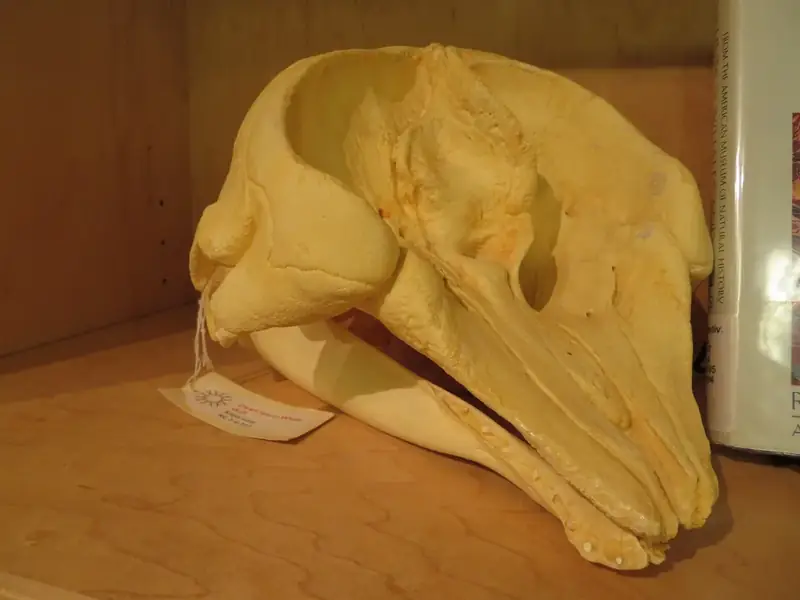
Most animals look about the same on the left and the right. A whale that swam off the coast of Peru about 6 million years ago did not. Its skull is so lopsided that the scientists who studied it first wondered whether it had simply been squashed in the ground.
It had not, they concluded. In a study published Nov. 9 in the journal Communications Biology, an international team led by researchers from the University of Zurich in Switzerland and Friedrich-Alexander-Universität Erlangen-Nürnberg (FAU) in Germany describes a new extinct species, Scaphokogia huachafo. The University of Zurich says it shows the most extreme facial asymmetry known in any whale or dolphin, "and possibly in any mammal." Asymmetry simply means the two sides do not match.
What the scientists found
The animal was a small relative of today's pygmy sperm whales. According to the University of Zurich, it lived between 6.3 and 5.6 million years ago, in a time geologists call the Late Miocene, and grew to about 2.7 meters long, or roughly 9 feet.
Here is what makes the skull so strange:
- Both nostrils on one side. Whales breathe through a blowhole, and under it the skull has bony nostril openings. In this whale, both openings sit entirely to the left of the midline. "The skull looks completely crooked," lead author Aldo Benites-Palomino said in the university's announcement.
- Mismatched face bones. The bones of the face differ a lot in size and position from one side to the other.
- A heavy, bent snout. The snout was a thick tube of dense bone, with cartilage that had turned to bone as well. It pointed 31 degrees downward compared with the rest of the skull. The university says this extra weight worked like ballast, shifting the animal's balance forward and down. Techlicious compared it to a scuba diver's weight belt.
- A head built to look down. Using a neck bone from a second Scaphokogia fossil, the team reconstructed how the head joined the body. The University of Zurich says the head could tilt downward by as much as 55 degrees. The Brighter Side of News, which went through the paper in more detail, reports that the study gives this as a range of reconstructed head positions, roughly 22 to 55 degrees, rather than a measure of how far the neck could bend.
Was it crushed? The researchers say no
Fossils can get bent and flattened by the weight of rock and sand over millions of years, so the team first had to rule that out. Benites-Palomino said the joints between the skull bones "are fully closed, and there are no fractures, pathologies or deformations elsewhere on the skull." Pathologies are signs of disease or injury.
"The species obviously possessed this extravagant appearance when it was alive," he said in FAU's announcement.
That is where the name comes from. Huachafo is a word in Peruvian Spanish for something over-the-top, showy or a bit tacky. "Its anatomy is so extravagant and odd that huachafo seemed the perfect name for it," Benites-Palomino said, as quoted by Techlicious.
A fossil that waited decades in a museum drawer
The skull came from the Pisco Formation, rock layers in the desert of southern Peru that are famous for well-preserved fossils of ancient sea life. It was dug up in the 1990s and stored at the Museum of Natural History in Lima. FAU says an early attempt to identify it failed, and the fossil was largely overlooked.
That changed in 2015, when Benites-Palomino, then a college student working on his bachelor's thesis, came across it in the collection. He went on to earn his doctorate at the University of Zurich in 2025 and is now an assistant professor at FAU. The Brighter Side of News reports that the skull, catalogued as MUSM 972, preserves most of an adult skull.
How it may have hunted
The researchers think this whale was a bottom feeder that worked the soft seafloor of shallow coastal waters. Its downturned snout and heavy head would have let it swim along just above the bottom, nose pointed at the mud.
Toothed whales find food by echolocation, which means they send out clicks and listen for the echoes, like sonar on a ship. The University of Zurich says toothed whales have lopsided skulls because the skull holds the organs that make those sounds. The team suspects that this whale's extra-crooked skull went with a sonar system aimed at the seafloor, to find prey hidden in the sediment. One clue: other sea mammals that feed on the bottom use whiskers or special eyesight, and the fossil shows no sign of either.
According to FAU, it probably sucked up its food, and it presumably went after octopus and squid, like its living relatives. The university says this way of life disappeared as ocean conditions changed at the end of the Miocene.
Meet its living cousins
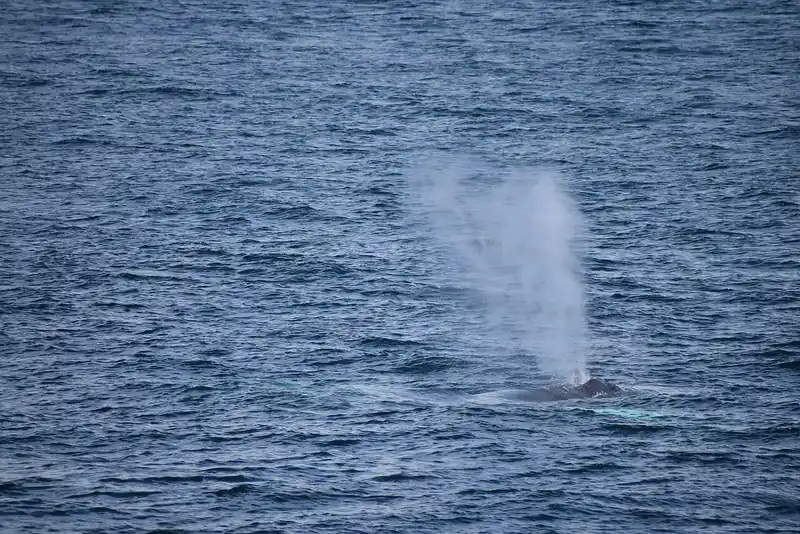
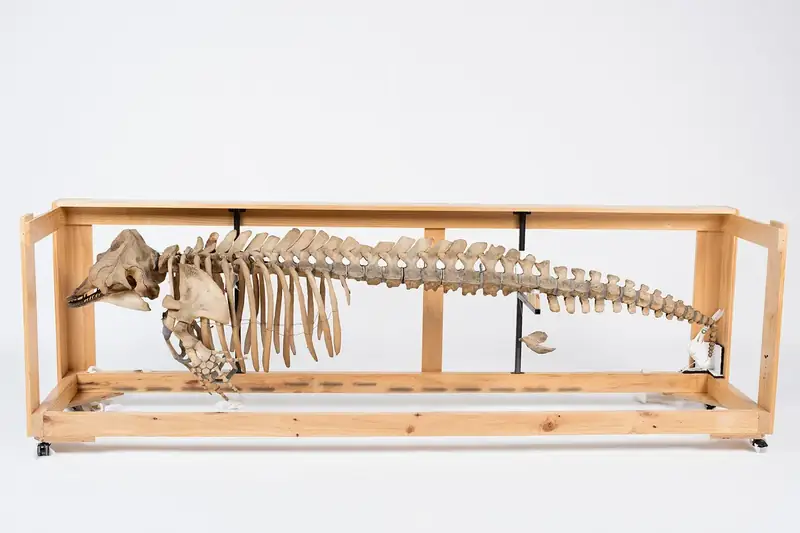
Two members of the family survive today, the pygmy sperm whale and the dwarf sperm whale. Few people ever see one. According to NOAA Fisheries, the federal agency that looks after marine animals:
- Size. Pygmy sperm whales grow up to 11.5 feet long and weigh 700 to 1,000 pounds. Dwarf sperm whales reach about 9 feet and 300 to 600 pounds, close to the size of the fossil.
- Where they live. Both live in warm and temperate seas worldwide. In US waters they are found off Hawaii, the Pacific Northwest, the North Atlantic and in the northern Gulf.
- What they eat. Squid and octopus, crabs and shrimp, and fish. They can dive at least 1,000 feet to find food.
- A disappearing act. When threatened, they can release more than 3 gallons of dark, reddish-brown liquid, an "ink" that clouds the water so they can escape.
- A shark-like look. Their pointed snout and narrow lower jaw make the head look a bit like a shark's. A pale mark behind the eye, called a "false gill," adds to the effect.
- Hard to spot. They spend very little time at the surface and almost never approach boats, so scientists rarely see them at sea.
Their big relative, the sperm whale, took the opposite path. FAU notes that sperm whales have less lopsided skulls and hunt squid in deep water, sometimes diving deeper than 3,000 meters, close to 2 miles.
What we still don't know
The find is striking, but it comes with limits:
- The "most crooked mammal" idea is a maybe. The university's own wording is "possibly in any mammal." The Brighter Side of News reports that the paper's ranking is narrower: this group of whales was the most lopsided among the toothed whales the team measured, and on one particular pair of face bones, a related species ranked even higher.
- The hunting style is an educated guess. It is based on the shape of the bones. The Brighter Side of News notes that the study does not directly show the whale aimed its sonar at the seafloor, and a fossil cannot tell scientists exactly what it ate.
- The evidence is limited. The description rests mainly on one skull, plus a neck bone from a second fossil.
Even so, the skull adds a new chapter to the story of these shy, little-known whales. Six million years ago, their family included a whale with a crooked face that spent its days nose-down, scanning the seafloor for a meal.
What do you think?
- Have you ever seen a whale, a dolphin or a whale skeleton in person, and where was it?
- Is there a museum fossil or exhibit you still remember from a childhood trip?
How we checked this story
We read 9 reputable sources, wrote this article in our own words, and link every one of them below. Last checked November 20, 2026.
- Benites-Palomino A. et al., "Extreme cranial asymmetry in extinct benthic feeding sperm whales," Communications Biology (Nov. 9, 2026): journal, title, date (the full paper was behind a login for us; its details come from the releases and coverage below)
- University of Zurich, "Prehistoric Whale Reveals Extreme Skull Asymmetry": species, age, length, nostrils, 31-degree snout, 55-degree head figure, ballast, Pisco Formation, 2015 find, crushing question and quotes, feeding idea, end of the Miocene, "possibly in any mammal"
- Friedrich-Alexander-Universität Erlangen-Nürnberg, "A truly bizarre find" (via EurekAlert): early failed identification, suction feeding, octopus and squid, modern sperm whales' depth and asymmetry, "extravagant appearance" quote, author's career
- The Brighter Side of News, "Six-million-year-old whale fossil reveals an extraordinarily lopsided face": specimen number, 22 to 55 degree range, caveats on the ranking, the sonar idea and diet
- IFLScience, "Bizarre Wonky Whale With Nostrils On One Side Of Its Face Swam Around The Oceans 6 Million Years Ago": independent check of age, length, nostrils, snout angle, meaning of the name
- Techlicious, "Meet huachafo, the ancient whale with a wildly crooked face": name quote, weight-belt comparison, college-thesis discovery
- ScienceDaily, "This 6-Million-Year-Old Whale May Have Had the Most Crooked Face in Mammal History": author list, how the story is being headlined
- NOAA Fisheries, "Pygmy Sperm Whale": size, range, diet, dive depth, ink, false gill, shark-like head, rarely seen
- NOAA Fisheries, "Dwarf Sperm Whale": size and range of the dwarf sperm whale
Spot an error? See our corrections policy.