Europe's Hera probe reaches the asteroid NASA hit in 2022; crash-site photos due Nov. 25
Four years after NASA's DART spacecraft slammed into a small asteroid on purpose, a European probe has arrived to see what the crash did. Here is what it has found so far, and how to watch the first close-up pictures next week.
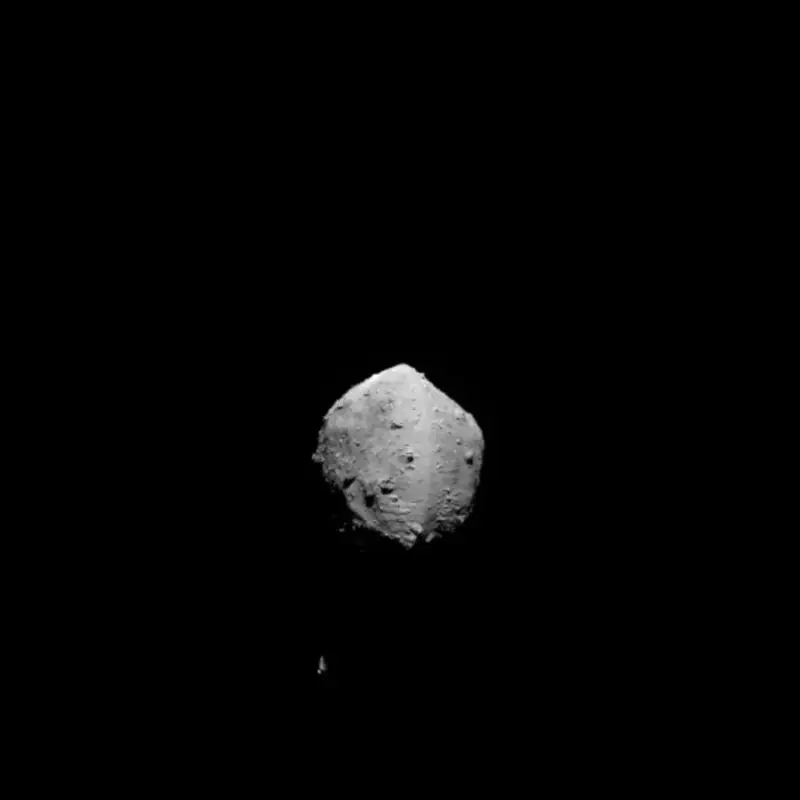
In September 2022, NASA flew a spacecraft into a small asteroid on purpose, to see whether a hard hit could nudge it off course. It worked. Now a European spacecraft called Hera has arrived at the same pair of asteroids to look at the damage up close, and its team says the first detailed pictures of the crash site will be shown on Wednesday, Nov. 25.
Why it matters: if a dangerous asteroid is ever found heading for Earth, ramming it with a spacecraft is one of the few defenses we have actually tested. Hera's job is to turn that one test into something engineers could repeat with confidence, by measuring exactly what the collision did.
What happened in 2022
NASA's Double Asteroid Redirection Test, or DART, struck a small asteroid called Dimorphos on Sept. 26, 2022. NASA put the speed at roughly 14,000 miles per hour. The European Space Agency (ESA) says the 580-kilogram (about 1,280-pound) craft threw up a plume of debris that spread across 10,000 kilometers (about 6,200 miles) of space.
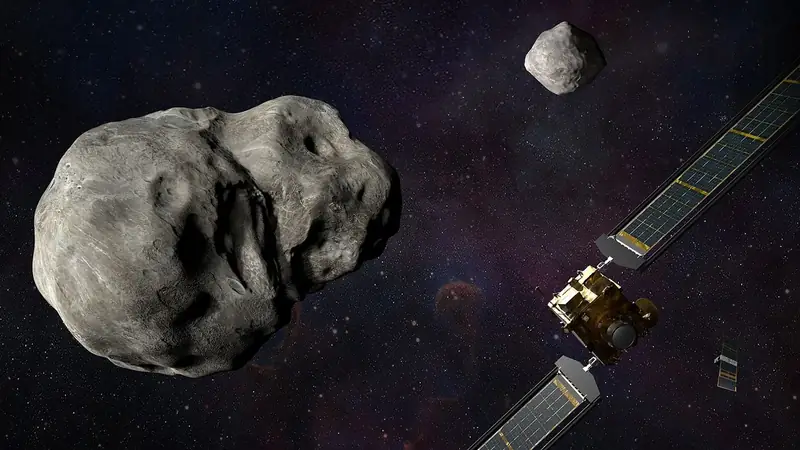
Dimorphos is a little moon that circles a bigger asteroid named Didymos. Before the crash, NASA says, one lap took 11 hours and 55 minutes. Two weeks after the impact, NASA announced the lap had been cut by 32 minutes, give or take about 2 minutes. NASA had said it would count as a success if the change was just 73 seconds, so DART beat that goal by more than 25 times. Later measurements put the change at about 33 minutes, the figure ESA now uses.
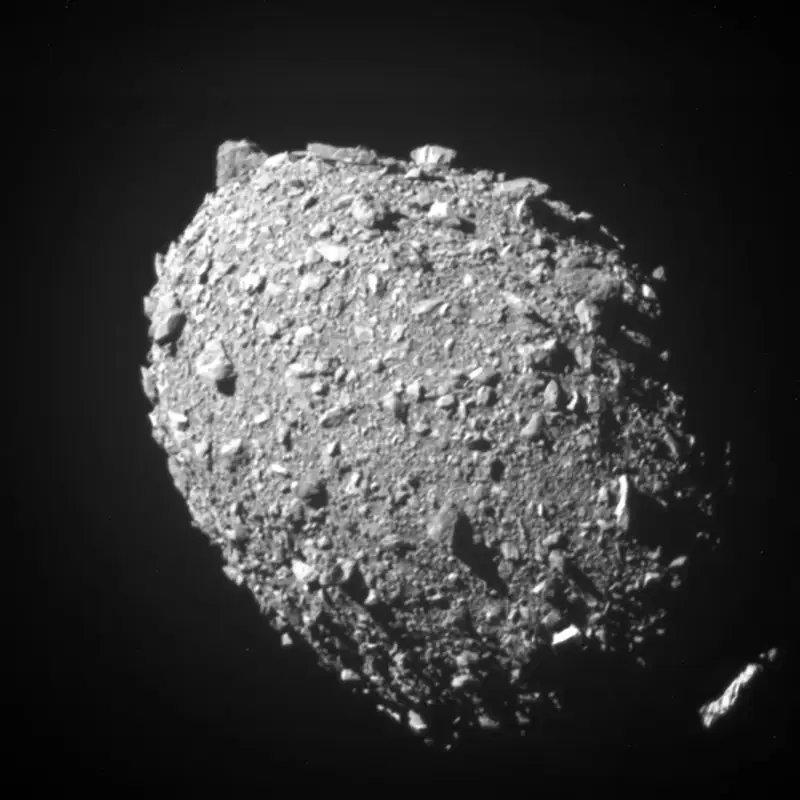
NASA also found that the hit pushed harder than the spacecraft alone could explain. Tons of rock blasted off the surface and shot into space, and that recoil added to the push, the way air rushing out of a balloon sends it flying the other way. A study NASA announced in March 2026, published in the journal Science Advances, found that DART even very slightly changed the pair's path around the Sun, NASA says.
One reassurance NASA has repeated from the start: neither asteroid was a danger to Earth before the crash, and neither is now.
The two asteroids, by the numbers
- Didymos. About 780 meters (about 2,560 feet) across, roughly half a mile. ESA says its gravity is about 40,000 times weaker than Earth's.
- Dimorphos. About 151 meters (about 495 feet) across, about one and a half football fields. Its gravity is about 200,000 times weaker than Earth's.
- The gap between them. About 1 kilometer, a little over half a mile, according to ESA mission scientist Michael Kueppers.
- Distance from us. ESA says mission control now talks to Hera across 196.5 million kilometers, about 122 million miles.
Hera's two-year trip
Hera, a spacecraft about the size of a small car, launched on a SpaceX Falcon 9 rocket from Cape Canaveral, Florida, on Oct. 7, 2024. On the way it swung past Mars in March 2025 and studied Mars's small moon Deimos, a test run for its instruments.
It reached the asteroid pair in early November. On Nov. 5, ESA released Hera's first close-up, taken from about 60 kilometers (37 miles) away. In it, Didymos is in plain view and Dimorphos is mostly hidden in its shadow.
"The first thing we said was wow!" said Hera's lead scientist, Patrick Michel of France's national research agency, CNRS. The picture shows the far side of Didymos, the one DART never saw. Michel said it has the same ridge around its middle seen in 2022, "but otherwise appears very different," with boulders, craters and what look like grooves.
Kueppers said some of those features may be debris from Dimorphos that drifted across the gap and landed on its bigger neighbor. Sorting out which marks are old and which came from the crash is part of the job.
Flying in rectangles
With gravity this weak, Hera cannot circle the asteroids the way a satellite circles Earth. Instead, ESA explains, it drifts in nearly straight lines at about 12 centimeters per second, about a quarter of a mile per hour, "about as fast as a rapidly-crawling insect." Every three or four days it fires its thrusters to turn 90 degrees. The result is a path shaped like a rectangle that keeps it about 25 to 30 kilometers (16 to 19 miles) from the asteroids.
The pattern is built to be safe. If a thruster firing ever fails, the spacecraft simply drifts away instead of crashing. ESA says the idea comes from its experience flying Rosetta, the probe it sent to a comet.
Hera is run from ESA's control center in Darmstadt, Germany. The team talks to it for about eight hours a day through four large dish antennas, each 35 meters (115 feet) wide, in Argentina, Spain and Australia.
What scientists want to learn
Watching from Earth told scientists that DART worked. It could not tell them how, or what the asteroid is like inside. ESA lists the big open questions:
- Did DART leave a crater, or reshape the whole asteroid? Computer models gave many different answers. "Hera will reveal which forecast was the correct one – if any!" the ESA team says.
- How heavy is Dimorphos, and what is it made of? Without the mass, scientists cannot say exactly how hard DART pushed.
- Why did it move more than expected? ESA says the deflection was "so much greater than impact simulations predicted," and the asteroid's makeup may explain why.
Some researchers also suspect the crash set Dimorphos wobbling. Before the impact it always showed the same face to Didymos, the way our Moon always shows us the same side. A study by DART team scientists in The Planetary Science Journal says Dimorphos may have been knocked into a tumble, and Hera should be able to see whether that is true.
How to watch on Nov. 25
ESA will show the first close-up pictures of Dimorphos in a live broadcast from the dinosaur hall of the Museum für Naturkunde, Berlin's natural history museum. It runs from 7:45 to 8:30 p.m. Central European Time on Wednesday, Nov. 25. That is 1:45 to 2:30 p.m. Eastern (10:45 to 11:30 a.m. Pacific), the day before Thanksgiving. ESA says it will stream on ESA WebTV and the ESA YouTube channel.
What comes next
This is only the first look. ESA says that in December, Hera will move closer, starting from about 20 kilometers away. Early in the new year it will release two shoebox-sized satellites, called Milani and Juventas, that can take more risks and fly closer than the main spacecraft. Eventually they will even try to land, according to Germany's space agency, DLR; ESA says Milani will attempt a landing on Dimorphos.
Mission manager Ian Carnelli said the team got here despite "our initial failure to secure funding, then a worldwide pandemic and finally an incoming hurricane" just before launch. His summary of the goal is simple: to help make Earth safer.
What we still don't know
Nobody yet knows what the crash site looks like, and the Nov. 25 pictures are the first chance to see it. The deeper answers, such as the asteroid's exact mass and what is inside it, will take months of close flying and the two small satellites. Pair-asteroid systems like this one make up about 15% of known asteroids, ESA says, so what Hera learns could help with many other space rocks, not just this one.
What do you think?
- Do you remember hearing in 2022 that NASA had crashed a spacecraft into an asteroid? What did you think of the idea?
- If an asteroid were ever found heading our way, would you trust a "bump it off course" plan like DART?
How we checked this story
We read 10 reputable sources, wrote this article in our own words, and link every one of them below. Last checked November 20, 2026.
- ESA, "Hera spacecraft in 'rectangular orbit' around target asteroids": arrival, 25-30 km distance, asteroid sizes and gravity, 12 cm/s, rectangular path and safety, Rosetta, ESOC control and antennas, 196.5 million km, DART mass, speed, plume, 33 minutes, open questions, December plans, Kueppers quotes
- ESA, "Watch live: Hera's first images of post-impact asteroid Dimorphos": Nov. 25 livestream time and venue, where to watch, CubeSats early next year, Carnelli quote
- ESA, "Hera takes flight: Didymos, here we come": launch date and rocket, Mars and Deimos flyby, binary asteroids about 15% of known asteroids
- NASA, "NASA Confirms DART Mission Impact Changed Asteroid's Motion in Space": 11 h 55 min orbit, 32-minute change and margin, 73-second goal, 14,000 mph, recoil from debris, no hazard to Earth
- DLR (German Aerospace Center), "Hera spots its target": arrival in early November, first image from about 60 km, CubeSats to attempt a landing, Nov. 25 detailed images
- NASA, "NASA's DART Mission Changed Orbit of Asteroid Didymos Around Sun": March 2026 Science Advances study, change to path around the Sun
- ESA, "Shoebox-sized Milani CubeSat joining Hera asteroid mission": CubeSat names, Milani landing attempt on Dimorphos
- Universe Today, "DART did more than deter Dimorphos, it sent it into a chaotic tumble": DART team paper (Planetary Science Journal) on possible tumbling
- BBC Sky at Night Magazine, "'Wow!' A spacecraft has arrived at an asteroid that a NASA probe crashed into": first images, Michel and Kueppers quotes, Dimorphos in shadow, more images due in November
- Popular Science, "Hera spacecraft photographs asteroid from 37 miles away": Nov. 5 image from about 37 miles, Nov. 25 release of detailed photos
Spot an error? See our corrections policy.