Strange gas leaking from Mars cracks hints the planet may not be volcanically dead
A European orbiter has spotted a gas called hydrogen chloride rising from fresh cracks near Mars's biggest volcano. Scientists say it may point to hot rock underground, but they have not proved it.
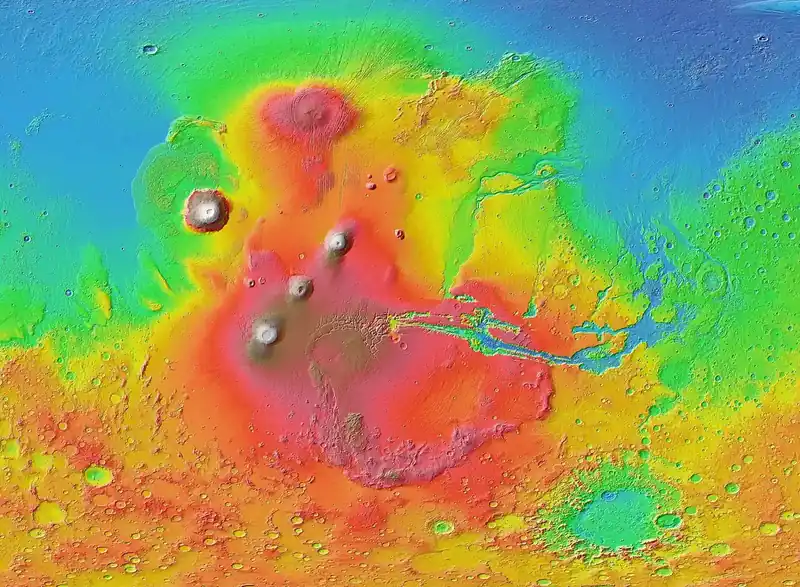
Mars has long been called a "dead" planet, at least when it comes to volcanoes. A new study suggests that may not be the whole story. A spacecraft circling the planet has found a gas seeping out of cracks in the ground near the biggest volcano on Mars, and the best explanation so far is hot, molten rock somewhere below.
The study was published Nov. 4 in the journal Science Advances. The gas is hydrogen chloride, a chemical that on Earth often comes out of volcanoes. The authors say the finding "hints at an igneous origin of this gas." Igneous means formed from hot, molten rock. It is a strong clue, not a proof, and the researchers say so themselves.
What the orbiter found
The paper is titled "Enigmatic HCl detections as a potential signature of igneous activity on Mars." HCl is the chemical shorthand for hydrogen chloride. It was led by Alexander Trokhimovskiy and colleagues. ScienceDaily, which republished the European Space Agency's (ESA) summary, lists 21 authors.
The data came from the ExoMars Trace Gas Orbiter, a European-Russian spacecraft that circles Mars. Its Atmospheric Chemistry Suite, a set of infrared instruments that can "taste" the chemistry of the thin air, first picked up hydrogen chloride in 2021, according to ESA. The American Association for the Advancement of Science (AAAS), which publishes the journal, says the gas showed up at parts-per-billion levels. That is a very small amount.
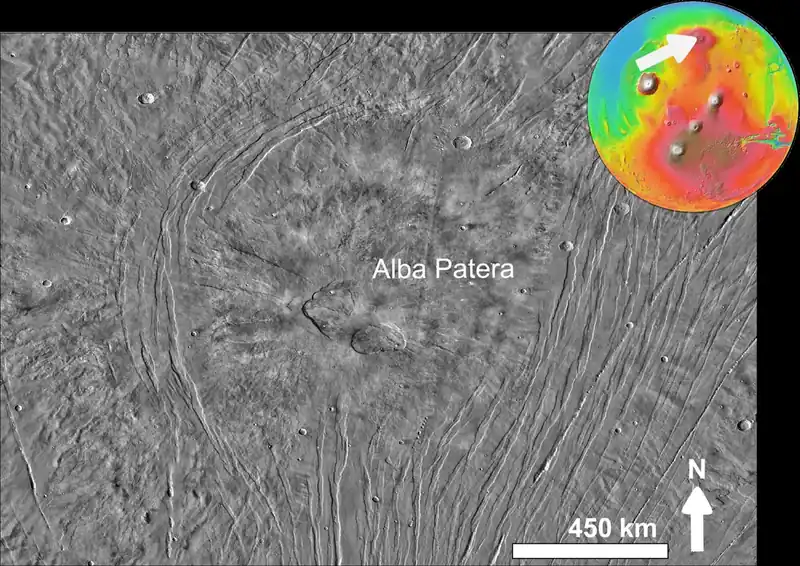
The new work ties that gas to a place. The AAAS release says the detections were over cracks in the surface near Alba Mons. ESA says the gas appeared in the early northern summer, soon after the winter frost had gone. The AAAS release describes the same observations as made in the cold "aphelion season," the part of Mars's year when it is farthest from the Sun. These two descriptions fit together. They are two ways of naming the same time of year.
Why Alba Mons matters
Alba Mons is the largest volcano on Mars by surface area, Futurism notes. It is huge and flat rather than tall and pointed. The fractures near it run for hundreds of meters, according to ESA, and Futurism describes them as thousands of feet long.
A camera on the same orbiter, called CaSSIS, also shows discolored ground near the cracks. ESA's summary says the team had to rule out other explanations for the gas before pointing to magma, which is molten rock under the surface. On Earth, gases escaping through cracks often leave colored mineral stains around the vents.
The team also says the pattern does not match what scientists normally expect. Hydrogen chloride on Mars usually peaks in the northern winter, ESA reports, and is thought to be tied mostly to dust and water cycles. Gas that turns up in the early summer over particular cracks is harder to explain that way.
What the scientists are saying
Daniel Mège, a professor at the Space Research Centre of the Polish Academy of Sciences and a co-lead author, used strong words in the ESA summary: "The Trace Gas Orbiter was able to find the smoking gun." He also said Mars "has retained enough internal heat to support volcanic activity until recently, and possibly still does."
Colin Wilson, ESA's project scientist for the orbiter, said the findings "may prove to be TGO's greatest success yet." TGO is short for Trace Gas Orbiter.
BBC Sky at Night Magazine adds some background. It says the volcanoes of Mars may have been active within the last few million years. That is recent in planet terms, but it is still a very long time by human standards.
What this does not mean
It is easy to read too much into this story, so here is what is not known.
- No eruption has been seen. ESA's summary says scientists have never directly watched a new eruption or fresh lava flow on Mars. This study does not change that.
- The source is not confirmed. The cause might be a magma chamber under Alba Mons, which ESA calls "possible." The team says that idea still had to be demonstrated and that other chemistry had to be ruled out.
- This is not proof of life. ESA states that the results do not establish that life exists beneath the surface of Mars.
- Only one team has weighed in so far. The sources we read quote the study's authors and an ESA scientist. We did not find independent scientists commenting yet, so expect more debate as other researchers look at the data.
Mège did suggest one follow-up. He told reporters, as Futurism quotes him, that looking for martian life in the seeping fissures of the Alba Mons region "would make a lot of sense." That is a suggestion about where to search, not a claim that anything lives there.
Why it matters for the rest of us
Mars is our best nearby test case for how a planet cools down over time. If a world smaller than Earth still has enough inner heat to power gas leaks today, that changes how scientists think about how fast rocky planets lose their warmth. Heat and water together are also what scientists look for when they ask where life could have survived.
Nothing here affects daily life on Earth. But it is a good reminder that a spacecraft already orbiting Mars, one that started working years ago, can still turn up surprises in its data. The orbiter keeps watching. ESA and the authors point to more seasonal monitoring and closer pictures of the cracks as the next steps.
What do you think?
- Do you remember where you were for a Mars landing or a big space moment, and how did it feel?
- Would you want to know the answer if scientists found signs of life under Mars's surface?
How we checked this story
We read 4 reputable sources, wrote this article in our own words, and link every one of them below. Last checked November 23, 2026.
- AAAS / Science Advances via EurekAlert, "Noxious gas discovered above cracks in the Martian surface suggests volcanic activity": paper title, DOI 10.1126/sciadv.aeb9422, Nov. 4 date, parts-per-billion levels, aphelion season, Trokhimovskiy quote
- ESA via ScienceDaily, "Mysterious gas leaks suggest Mars may still be volcanically alive": 21 authors, 2021 first detection, early summer timing, fractures, CaSSIS camera, Mège and Wilson quotes, caveats
- Futurism, "Orbiter Detects Signs of Activity on Mars": Alba Mons largest by surface area, fissure length, Mège quote on searching for life
- BBC Sky at Night Magazine, "Mars volcano images show signs of activity": volcanoes active within the last few million years, no eruptions observed
Spot an error? See our corrections policy.