Hera's first look at NASA's asteroid crash site: a stadium-sized crater
Europe's Hera probe has sent back the first pictures of the crater NASA's DART spacecraft left on a small asteroid in 2022. Here is what it shows, and what surprised scientists.
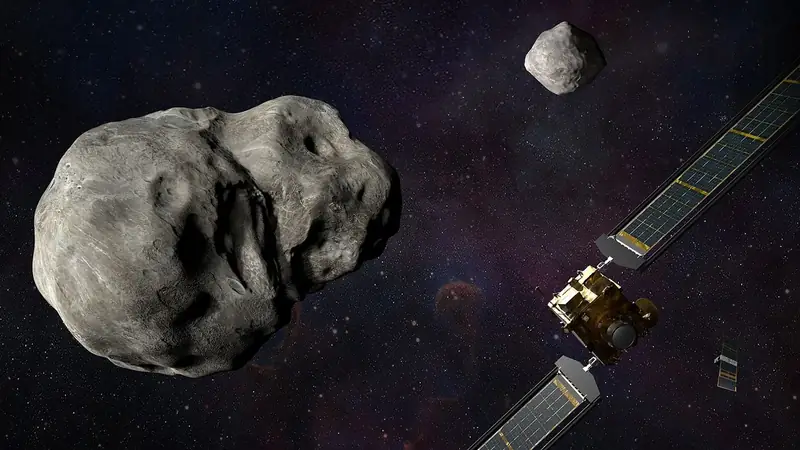
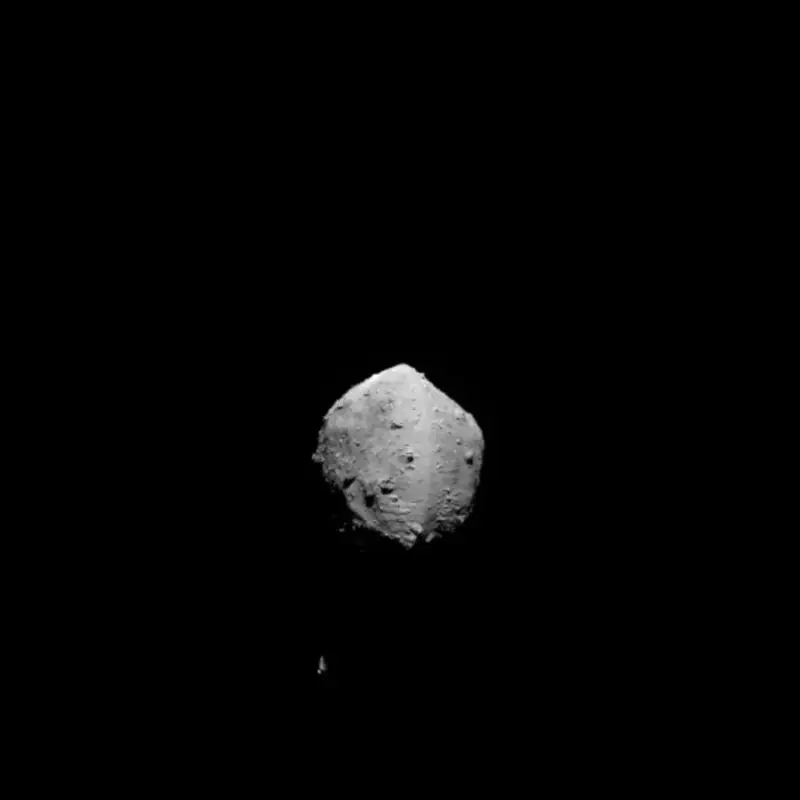
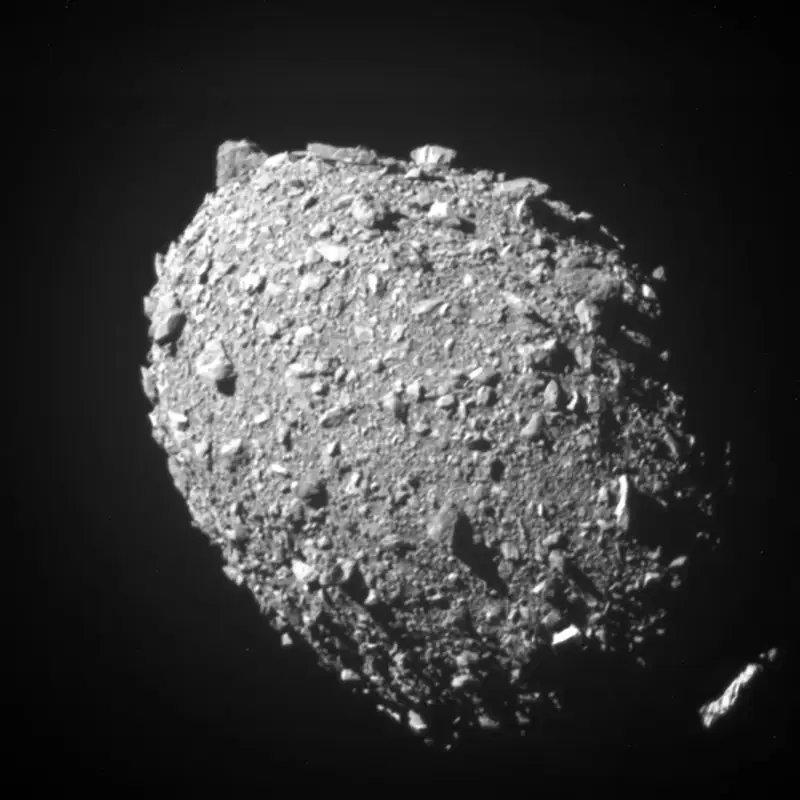
The first close-up pictures of the place where NASA crashed a spacecraft into an asteroid are in. The European Space Agency (ESA) said on Wednesday that its Hera probe has photographed a crater "the size of a sports stadium" on a small asteroid named Dimorphos.
Why it matters: the 2022 crash was the first real test of whether we could knock a dangerous asteroid off course. It worked. Now Hera is showing what the hit actually did to the rock, which helps engineers plan for any future threat.
What Hera saw
According to ESA, one face of Dimorphos is now flattened by a crater that stretches across the asteroid's entire width. Dimorphos is about 151 meters (roughly 500 feet) across, so the crater is nearly as wide as the whole rock.
Julia de León of the Instituto de Astrofísica de Canarias (IAC), a Spanish research institute, said the crater is very big and "seems to have some weird structures inside it." Other parts of Dimorphos look just as they did in DART's pictures from 2022, ESA says. Its boulder fields are unchanged.
The larger asteroid, Didymos, is about 730 meters across. The IAC says it shows no apparent change from the impact, with the same boulder fields and the same ridge around its middle.
Hundreds of loose boulders
A surprise came from the long-exposure images. ESA says hundreds of previously unknown boulders circle the two asteroids. Michael Kueppers, an ESA Hera mission scientist, described them as just a few meters in size.
The IAC says the boulders appear in motion around the system. Scientists have not said exactly where they came from. They could be rocks thrown out by the 2022 crash, or something else.
ESA also says the DART impact left Dimorphos tumbling chaotically in its orbit. In plain terms, the little asteroid wobbles instead of spinning neatly.
The numbers behind the crash
- The hit. According to the IAC, DART weighed 576 kilograms (about 1,270 pounds) and struck Dimorphos at 6.1 kilometers per second, on Sept. 26, 2022.
- The nudge. The crash shortened the time Dimorphos takes to circle Didymos by 33 minutes, from 11.92 hours to 11.37 hours, per the IAC. ESA calls that much greater than predicted.
- The distance. The pair is about 193.5 million kilometers from Earth, ESA says. They are not a threat to us.
- The cameras. Hera took the pictures from about 25 to 30 kilometers away. It used a black-and-white camera, a 25-color camera called Hyperscout H, and a heat-sensing camera built by Japan's space agency.
What comes next
Hera is a small-car-sized spacecraft that reached the asteroids in early November 2026 after a two-year trip. ESA says that in December it will move to about 13 kilometers from the asteroids and send back sharper images. In January it will release two shoebox-sized CubeSats, called Milani and Juventas. The Planetary Society notes Hera will keep studying the pair for several months. The IAC says the work runs until June 2027.
Juventas carries a tiny radar to peer inside Dimorphos. ESA says it will eventually attempt a landing. Hera's team wants to measure the crater precisely and learn what Dimorphos is made of.
What it means for you
Nothing here puts anyone at risk. No known asteroid is headed for Earth. But a rehearsal like this is how planetary defense gets real. Knowing how a rubble-pile asteroid reacts to a hit tells engineers how hard, and from how far, they would need to push a future threat.
Not everything is settled. One outlet, Engadget, wrote that DART changed the pair's path around the Sun. ESA's own description is of the change in Dimorphos's orbit around Didymos, and we use that. Also, ESA has not given the crater's size in meters yet. "Stadium-sized" is its description, and measurements are still to come.
What do you think?
- Do you remember watching the DART crash in 2022? What did you think when you heard NASA was doing it on purpose?
- Should countries keep spending on asteroid defense, even if no threat is known today?
How we checked this story
We read 4 reputable sources, wrote this article in our own words, and link every one of them below. Last checked November 25, 2026.
- ESA, "Hera reveals stadium-sized asteroid crater left after spacecraft impact": crater description, sizes, boulders, tumbling, 33 minutes, distances, instruments, next steps, quotes
- Instituto de Astrofísica de Canarias, "ESA's Hera mission reveals the first images of asteroid Dimorphos after the DART impact": DART mass and speed, orbit times, de León quotes, Didymos unchanged, mission timeline
- Engadget, "NASA's DART mission left a stadium-sized crater in an asteroid, the ESA finds": crater width, unchanged boulder fields, camera distance, CubeSat plans
- The Planetary Society, "Hera's first close-up images of Didymos and Dimorphos": crater visible, CubeSat timing, several months of study
Spot an error? See our corrections policy.